Security | Updated: November 2026
Update 19 November: Debian has now released its official fix for Debian 13 (1.26.3-3+deb13u11). If you installed our Debian 13 package, a normal apt upgrade switches to Debian's version automatically. Debian 12, Debian 8 to 11 and CentOS 7/8 still have no official fix; our packages cover them.
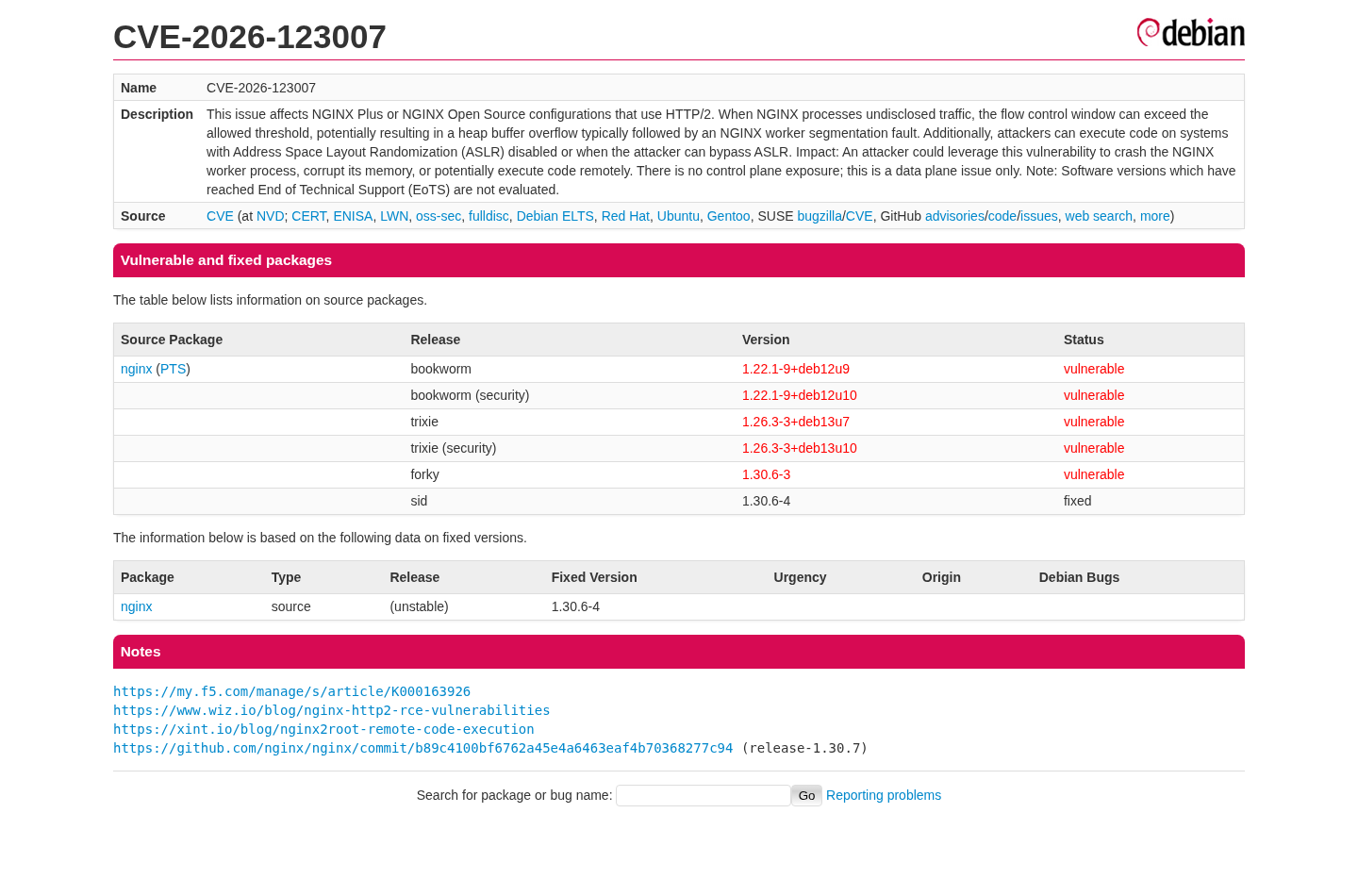
On 18 November 2026, security researchers at Xint published nginx2root (CVE-2026-123007 and four related CVEs): five vulnerabilities in NGINX, the web server in front of a large part of the internet, and a Linux kernel bug that turns them into full control of the server. The most serious one hits every NGINX with HTTP/2 switched on, in every release since 2015. No login, no vulnerable plugin, just one connection.
NGINX released fixed versions. On Debian, one of the most used Linux distributions for web servers, the fix had reached only the development branch: the next morning, Debian 12 and 13 were still marked vulnerable, and Debian 8 to 11 and CentOS 7 are out of support. So we built the fixed packages ourselves. Our own servers were patched the same day, and the next morning we put the packages on GitHub for everyone.
Download the patched packages on GitHub
The short version: nginx2root lets an attacker run code on an NGINX server and, combined with the kernel bug, become root, even from inside a Docker container. Our packages carry NGINX's official fixes for Debian 8 to 13 and CentOS 7. They install like a normal update, and the official update replaces them automatically as soon as it arrives. Hosted Power customers were patched on the day of disclosure, without doing anything. Everyone else can use them for free.
Switching off HTTP/2 does NOT fix nginx2root. Many hosts and admins are turning HTTP/2 off right now, but that closes only two of the five vulnerabilities (CVE-2026-123007 and CVE-2026-123633). The other three stay open: DNS lookups during a request (CVE-2026-123634), the mail proxy (CVE-2026-113425) and HTTP/3 (CVE-2026-121810). On top of that, it costs every visitor speed: browsers fall back to HTTP/1.1, with more connections and no multiplexing, and gRPC stops working. With our packages, HTTP/2 can stay on. How to switch it back on.
In this article
- What nginx2root is
- The gap between the fix and your server
- Keep HTTP/2 on
- What we built
- Made to step aside
- Second time in a month
- The part that is specific to Hosted Power
- Where the packages stop helping
What nginx2root is
nginx2root is not one bug but six. Five are in NGINX itself. Each one can lead to code execution on its own, but each needs a different setup:
- HTTP/2 (CVE-2026-123007). The worst of the five: a memory corruption in HTTP/2 flow control, present since NGINX added HTTP/2 in 2015. If your site is served over HTTP/2, which almost every modern HTTPS site is, it is exposed.
- HTTP/2 towards a backend (CVE-2026-123633). NGINX passing HTTP/2 requests on to an application server, the most common setup there is.
- HTTP/3 towards a backend (CVE-2026-121810). The same idea on HTTP/3, in newer NGINX versions.
- DNS lookups during a request (CVE-2026-123634). Setups that choose their backend per request and send subrequests, for example with SSI or
mirror. - The mail proxy (CVE-2026-113425). NGINX used as a proxy in front of mail servers.
On its own, a successful attack runs code as the NGINX worker, which has limited rights. The sixth bug, in the Linux kernel's SCTP code, removes that limit: Xint chained it to become root on the host, also from inside a Docker container. The researchers are holding back the kernel details until a kernel fix is out.
Xint's advice was clear: update NGINX as soon as a fixed version is available. Until then, switching off HTTP/2 blocks two of the five routes, but not the other three, and it breaks services that need HTTP/2, such as gRPC.
The gap between the fix and your server
NGINX published fixed releases, 1.30.7 and 1.31.9. But most servers do not run NGINX straight from nginx.org. They run the version their Linux distribution ships, and they get updates when that distribution releases them.
Debian packaged the fix quickly, but only in its development branch. On the morning of 19 November, the Debian security tracker still showed the stable releases, Debian 12 Bookworm and Debian 13 Trixie, as vulnerable. Debian 8 to 11 no longer receive regular Debian updates at all, and CentOS 7 reached its end of life in June 2024.
For an administrator, that left three options: switch off HTTP/2 and stay exposed to the rest, build NGINX by hand and leave the distribution's update path, or wait. We did not like any of the three.
Keep HTTP/2 on
Switching off HTTP/2 feels like the safe choice, but it does not fix all vulnerabilities: three of the five stay open, and you give up speed on every request. Installing the fixed package closes all of them, with HTTP/2 left on.
Already switched it off? Install the patched package (it restarts NGINX by itself), then switch HTTP/2 back on: listen 443 ssl http2; on Debian 9 to 12, CentOS 7 and CentOS 8, or http2 on; on Debian 13. Check with nginx -t and reload.
What we built
We took the official fixes as Debian packaged them, applied them to the exact NGINX version each system ships, and built packages that are identical to the system's own in every other way: same configuration paths, same modules, same build options.
- Our managed servers ran the patched packages on 18 November, the day nginx2root was disclosed.
- Debian 12 Bookworm and Debian 13 Trixie went public on GitHub the next morning, 19 November.
- Debian 9, 10 and 11 followed within the hour, and Debian 8 after them. For these releases we started from the sources of Freexian's Extended LTS, which still maintains them. Their older NGINX code needed small, checked adaptations of the same fixes.
- CentOS 7, still running on many older servers, gets the same fixes as RPM packages.
- Every fix is included wherever the affected code exists. The HTTP/3 fix, for example, is only in the Debian 13 package, because the older releases ship an NGINX without HTTP/3.
Every package was tested in a clean installation of its own release: upgrade from the vulnerable version, configuration check, and a live HTTP/2 request. The build is public and reproducible, so anyone can check that the packages contain exactly what we say. The included installer upgrades only the NGINX packages a server already has, checks the configuration before and after, and confirms that NGINX is still running.
Download and install instructions: github.com/HOSTED-POWER/nginx2root-patches
Made to step aside
Our packages carry the complete fixes, so there is no need to wait for anything else. But a patched package should never get in the way of later updates either. Ours are numbered so that they sit just above the vulnerable version and just below the next official update. No pins, no holds, no renamed packages.
In practice: the moment Debian publishes its official update, a normal apt upgrade or unattended upgrades replaces our package with Debian's. Nobody has to remember to remove anything.
Second time in a month
This is the second time in a month that a critical bug landed in software almost every website depends on, with no ready fix for a large part of the servers running it. In October it was PHP: php2shell, where we protected PHP before the official patch existed and open-sourced the fix for PHP 5.4 to 8.5.
The researchers point out why this keeps happening: NGINX recorded two vulnerabilities in 2025, and 26 in 2026 before nginx2root even came out, as AI-assisted research finds bugs faster than ever. Fixes from the original developers come quickly. The weeks between that fix and the update your distribution ships are where servers get caught.
Not sure where your servers stand?
Which servers run NGINX with HTTP/2, which use the mail proxy or per-request DNS lookups, and which ones are on a Debian release that no longer gets updates: that is often harder to answer than it sounds.
Request an infrastructure audit
The part that is specific to Hosted Power
The packages are open source, and anyone can use them. What makes the difference for our customers is everything around them.
We could read the fix, not just wait for it. Backporting a security fix to every NGINX version from Debian 8 to 13 and CentOS 7, the oldest from 2014, and proving that each one still closes the hole, is careful engineering work, not a configuration change.
We have our own package repository. Our managed servers got these packages from it on the day of disclosure, the same way they get every other update, and Debian's official update will replace them there just as smoothly. TurboStack manages every server the same way, so we know where NGINX runs and how it is configured.
We look after the layer below as well. nginx2root needs a kernel bug to become root. We maintain our own kernel and close kernel vulnerabilities with live patching, without a reboot.
Where the packages stop helping
There are clear limits, and we prefer to state them explicitly.
They cover nginx2root, not everything. NGINX 1.30.7 fixes a few more, less severe problems that are not part of nginx2root. Debian's next update will bring those.
Debian and CentOS 7 on x86_64 only, for now. No ARM builds yet, and no packages for Ubuntu, other distributions, or NGINX from nginx.org's own repository.
They do not fix the kernel. The SCTP bug needs a kernel update, and its details are not public yet. Keep your kernel patched.
Debian 8 to 11 and CentOS 7 are out of support. A fixed NGINX on an old system does not make the rest of that system safe.
Open source, because the internet is shared
We built these packages for our own servers first. But every unpatched NGINX on the internet is a potential starting point for the next attack, so sharing them was the obvious thing to do, just like with php2shell.
For our customers, the result is simple: the complete fix on the day of disclosure, a seamless handover when Debian's own update lands, and nothing to do on their side.
If you run NGINX on servers you can't update yet, ask us to review your infrastructure. We'll tell you where you stand and what the safest route is.
Sources: Xint's nginx2root disclosure, NGINX security advisories, Debian security tracker.