The unique benefits of having your Kubernetes environment managed
Kubernetes is the fastest and easiest way to manage containers. We can take care of everything for you, since managing them involves more than you might think.
Kubernetes: a little background
Kubernetes is an open-source platform for managing containerized workloads and services, enabling both configuration and automation. It has a large, fast-growing ecosystem.
The name Kubernetes comes from Greek and means helmsman or pilot.
Google made the Kubernetes project open source in 2014. Kubernetes combines more than 15 years of Google’s experience with large-scale production workloads with the best practices of the open-source community, of which Hosted Power is, of course, a big fan.
K8S is an abbreviation formed by counting the eight letters between the “K” and the “s”.
The evolution leading to the K8S era
Traditional deployment
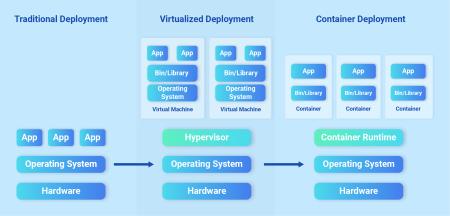
In the beginning, organizations ran applications on physical servers. There was no way to define resource limits for applications or a physical server, which could potentially cause problems with resource allocation. For example, if multiple applications are running on a physical server, one application might consume most of the resources, causing the other applications to perform poorly.
One solution would be to run each application on a different physical server. Since this solution is not scalable, it became an expensive option for organizations. When something becomes too expensive, innovation follows. Enter virtualization.
Virtualization
Virtualization was introduced as a solution. It lets you run multiple virtual machines (VMs) on the CPU of a single physical server. Virtualization isolates applications from one another in separate VMs and provides a level of security, since one application cannot freely access another application’s information.
Virtualization makes better use of a physical server’s resources and allows for greater scalability, because applications can easily be added or updated. This reduces hardware costs. With virtualization, you can present a set of physical resources as a cluster of virtual machines.
Well-known “hypervisors” for managing virtual systems include VmWare, Openstack and KVM.
Each VM is a complete, standalone machine that runs all components, including its own operating system, on top of the virtualized hardware. As you can probably tell from that last sentence, there is still room to optimize resource usage. This became possible with the introduction of containers.
Containers
Containers are similar to VMs, but their properties are more flexible, allowing the operating system (OS, such as Windows or Linux) to be shared between applications. That is why containers are considered lightweight. Like a VM, a container has its own file system, CPU share, memory, process space and more. Because they are decoupled from the underlying infrastructure, they are portable across clouds and operating systems.
How does a Kubernetes cluster work?
We could talk about this for hours, but here is a brief overview. A Kubernetes cluster essentially consists of:
- A control plane that makes global decisions about the cluster, detects cluster events and responds to them. This control plane is made up of several control plane components.
- A set of nodes, worker instances that contain the services needed to run pods , keep active pods running and provide the Kubernetes runtime environment.
“Using Kubernetes is a great experience. Running it in production is much less straightforward. And building a managed Kubernetes platform is even more complex.”
Deploying the Kubernetes cluster is only the beginning. To consider it production-ready, you also need to ensure that:
- The installation process can be automated and repeated
- The upgrade and rollback process is safe
- A recovery procedure is in place and is documented and tested
- Performance is predictable and consistent, especially when using persistent volumes
- The cluster is usable, with sufficient support, metrics and logs to detect and debug errors and issues
- The service is secure and available
If you thought setting up your new Kubernetes cluster would give you complete operational freedom, it seems you were mistaken. Kubernetes itself is a management tool that should not be underestimated, and deployment and maintenance can quickly take up a lot of time and effort.
So, as with many powerful technologies, Kubernetes’ apparent simplicity and versatility on the Dev side come with considerable complexity on the Ops side. That is reason enough for Hosted Power to launch a managed Kubernetes solution. Combined with our TurboStack® technology, we can develop a tailored, end-to-end solution for your container application, fully managed by Hosted Power. However, because we believe in transparency, you can also get insight into how it works.
Our managed Kubernetes solution is entirely open source-based, vendor-lock-in-free and 100% compatible with any other Kubernetes solution. Our goal is to provide our partners with a fully managed, out-of-the-box Kubernetes cluster that is ready to use, with no installation or operational hassle. That’s what we stand for!
Interesting updates, technical deep dives, quirky visions in the ICT or hosting landscape.
Our colleagues got down to business to give you insight into what's going on at Hosted Power.
This article was written by:
Tim Terreur
Managing Partner